

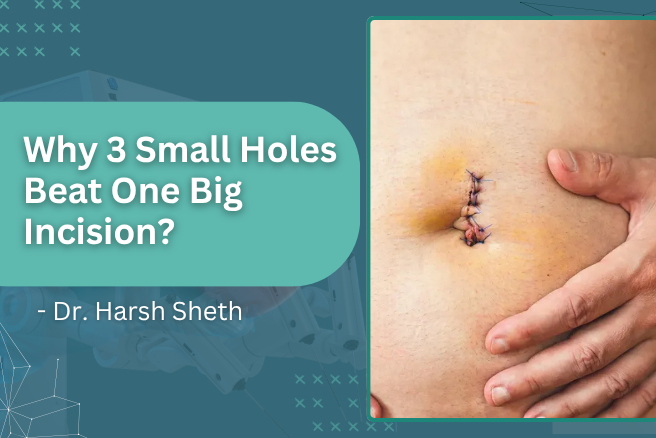
Laparoscopic surgery replaces one large abdominal incision with three small ports, each under a centimetre wide. A camera and surgical instruments pass through these ports, giving the surgeon full visibility and control without cutting through major muscle groups. The result is less tissue trauma, lower infection risk, faster healing, and a significantly shorter recovery compared to conventional open surgery.
According to Dr. Harsh Sheth, laparoscopic surgeon in Mumbai, “A smaller entry point means less trauma to the body, and less trauma means the patient heals faster, hurts less, and gets back to normal life sooner than anyone expected.”
Want to know if your condition can be treated laparoscopically?
What Makes 3 Small Ports Better Than One Large Incision?
It’s not just about the size of the cut. It’s about what the cut does to surrounding tissue, muscle, and the body’s ability to recover.
- Muscle fibres stay intact: Open surgery cuts through abdominal muscle to reach internal organs, laparoscopic ports slip between muscle fibres without severing them, which is why post-op pain is significantly lower and core strength returns faster.
- Infection risk drops sharply: A large open wound exposes internal tissue to the environment for the entire duration of surgery, smaller port sites carry far less contamination risk and studies consistently show lower surgical site infection rates with laparoscopic approaches.
- Hospital stay shrinks: Patients undergoing open abdominal surgery typically stay 5 to 7 days, laparoscopic patients often discharge in 24 to 48 hours because the body hasn’t taken the same level of trauma and doesn’t need as long to stabilise.
- Internal scarring is reduced: Less tissue handling during laparoscopic procedures means fewer adhesions form post-operatively, which matters a lot for patients who may need further abdominal surgery later in life.
Smaller incisions don’t mean smaller capability. The same complex procedures done through open surgery are now routinely performed through three ports by experienced surgeons. Learn how this applies to hernia surgery in Mumbai and what laparoscopic repair means for your recovery.
When Do 3 Holes Actually Beat a Big Cut in Clinical Practice?
Theory is one thing. What actually happens in the operating theatre and recovery ward is where laparoscopic surgery proves its case.
- Pain scores are consistently lower: Multiple clinical studies show post-operative pain scores are significantly lower in laparoscopic groups compared to open surgery groups, patients use less analgesia and report better comfort from day one.
- Return to normal activity: Most laparoscopic patients return to light activity within a week, open surgery patients typically need four to six weeks before their abdominal wall is strong enough to handle normal movement.
- Cosmetic outcomes: Three tiny port scars are essentially invisible at six months while a large midline incision leaves a permanent visible scar, something patients consistently rank as important in quality-of-life assessments after surgery.
- Across bariatric surgery and GI procedures: Whether it’s a gastric bypass, sleeve gastrectomy, cholecystectomy, or hernia repair, laparoscopic access consistently delivers shorter hospital stays, fewer complications, and faster recovery than the open equivalent.
The clinical case for laparoscopic surgery isn’t just about comfort. It’s about fewer complications, better outcomes, and faster return to the life the patient had before they needed surgery. Read more on post-op recovery.
Why Choose Dr. Harsh Sheth
Dr. Harsh Sheth is a Fellow in Advanced Minimal Access and Bariatric Surgery with over ten years of specialised experience, trained under Dr. Muffazal Lakdawala at Saifee Hospital, and a Stanford-India Biodesign Fellow with multiple medical device patents. He consults at Saifee Hospital, Breach Candy Hospital, Jaslok Hospital, and Genèse Clinic.
Over 5,000 minimally invasive procedures performed. Patients come in worried about recovery time and leave surprised by how fast it actually went. That gap between expectation and experience is what laparoscopic surgery consistently delivers. Call +91 91370 80299 to book your consultation.
Frequently Asked Questions
Is laparoscopic surgery safe for all abdominal conditions?
Most abdominal conditions can be treated laparoscopically, though suitability depends on the patient’s anatomy and surgical complexity.
Does laparoscopic surgery take longer than open surgery?
Operative time is sometimes slightly longer but patients recover significantly faster, making overall treatment time shorter.
Are the 3 port incisions painful after surgery?
Port sites cause mild localised soreness for a few days, far less than the pain associated with a large open surgical incision.
Can laparoscopic surgery be converted to open surgery mid-procedure?
Yes, if complications arise the surgeon can convert to open surgery at any point to ensure patient safety.
Disclaimer – This blog is for educational and informational purposes only and should not be considered professional advice.
