

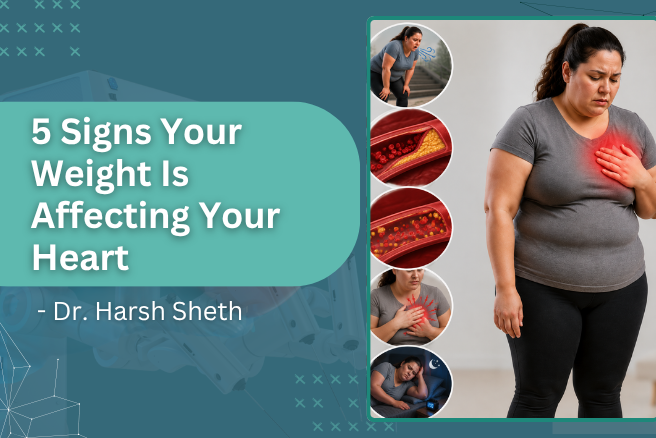
Excess weight makes your heart work overtime. Every extra kilo means more blood vessels, more pressure, more pumping. And the heart wasn’t built to keep up forever. The damage shows up as breathlessness on small efforts, blood pressure that won’t settle, swollen ankles by evening, a pulse that skips, and lipid panels that keep getting worse. Bariatric surgery enters the picture once BMI hits 37.5 kg/m² in Asians, or 32.5 kg/m² when cardiac issues refuse to back down despite medication.
According to Dr. Harsh Sheth, Bariatric Surgeon in Mumbai, Obesity isn’t a cosmetic concern. The fat surrounding the heart muscle alters its electrical activity, and most patients don’t realise this until they land in cardiology.
What Are the Five Signs Your Weight Is Damaging Your Heart?
Most of these signs creep in slowly. People blame age, work stress, the weather. The heart, meanwhile, keeps absorbing the load.
Warning Sign | What You Notice |
Breathlessness | One flight of stairs and your chest feels packed, you’re breathing shallow, and getting back to normal takes way longer than it should |
Hypertension | BP keeps sitting above 140/90 even on meds, because the heart’s pushing blood through tissues thick with fat |
Swelling | By evening your ankles puff up, shoes feel tight, calves hold water, your right heart isn’t draining venous blood like it used to |
Palpitations | A flutter here, a racing pulse there, sometimes full atrial fibrillation, and obese patients see this far more than anyone else |
Anyone past Class 1 obesity should be doing cardiac checks regularly. Don’t skip them. And when metabolic numbers slide alongside the heart symptoms, a laparoscopic surgical evaluation often becomes the next sensible step.
When Does Bariatric Surgery Become Medically Necessary for Heart Health?
Surgery isn’t the opening move. It’s what happens when diet, medication, and willpower have already taken their swings and the heart is still bleeding pressure.
BMI threshold: BMI over 37.5 kg/m² in Asians, or 32.5 kg/m² with cardiac comorbidities sitting on top, and you’re firmly inside surgical criteria.
Failed management: Two years or more of supervised dieting, structured exercise, drug therapy, and the scale barely moves while the heart numbers worsen.
Comorbidity stack: Diabetes plus sleep apnea plus hypertension plus bad lipids. That’s not a list, that’s a stacking problem, and it’s why weight loss surgery in Mumbai gets framed as cardiac prevention more than aesthetics.
Cardiologist clearance: Before surgery, full cardiac workup. After surgery, follow-up scans usually show ejection fraction climbing within a year. Real numbers, real change.
So the call isn’t made fast. It’s made together, with proper data behind it. Want more on who actually qualifies? Read Why Your BMI Alone Doesn’t Decide if Bariatric Surgery Is for You.
Why Choose Dr. Harsh Sheth?
Dr. Harsh Sheth has spent over ten years doing advanced laparoscopic and bariatric surgery. M.S. in General Surgery from Seth G.S. Medical College and KEM Hospital, plus a Stanford-India Biodesign fellowship to back the clinical depth. He operates across Saifee, Breach Candy, and Jaslok, and you can read more about Dr. Harsh Sheth directly.
His patients dealing with obesity-strained hearts have come off BP meds, watched sleep apnea disappear, and seen ejection fraction climb inside the first year. That’s not marketing. That’s follow-up data on a clipboard.
Frequently Asked Questions
Can obesity cause a heart attack even without high cholesterol?
Yes, obesity stresses the heart on its own through inflammation and pressure load.
How quickly does the heart recover after bariatric surgery?
Most patients see solid improvement inside six to twelve months.
Is bariatric surgery safe for patients with existing heart disease?
Yes, with cardiologist sign-off and a careful pre-op workup.
Does weight regain after surgery affect heart health again?
Yes, holding the weight off matters for long-term cardiac protection.
Refrences
