

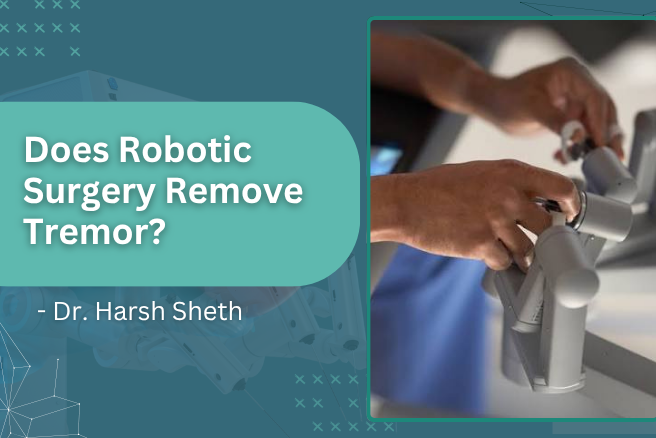
Human hands shake. Not a lot, not noticeably in everyday life, but under a laparoscope working millimetres from a bile duct or a blood vessel, even a small tremor is a problem. Robotic systems like the da Vinci filter those hand movements electronically before translating them into instrument motion. The result is a steadier instrument tip than any unassisted human hand can produce. Add 3D magnification, motion scaling, and wristed instruments with more range of movement than a wrist joint, and you have a setup that handles complex GI anatomy more safely than conventional laparoscopy does.
According to Dr. Harsh Sheth, an expert in robotic surgery in Mumbai, “In complex GI procedures, working close to critical structures leaves no margin for instrument drift. Tremor filtration isn’t a convenience feature, it’s what makes certain dissections reliably safe.”
Considering robotic surgery for a GI condition?
How Does Tremor Filtration Actually Work in Robotic Surgery?
It’s not magic and it’s not complicated once you understand the setup. The surgeon never physically holds the instruments at all.
- Console-to-instrument translation: The surgeon sits at a console metres away from the patient, hand movements go through software before reaching the robotic arms, and that software filters out any oscillation below a threshold frequency before it gets translated into instrument motion.
- Motion scaling: Beyond just removing tremor, the system scales down the surgeon’s gross hand movements, a 2cm movement at the console becomes a 1mm movement at the instrument tip, which is how procedures in tight anatomical spaces become manageable that would otherwise require open access.
- Wristed instruments: Standard laparoscopic tools move in four directions, robotic instruments articulate in seven, which means the surgeon isn’t fighting instrument geometry to stay steady near a vessel or duct, the tool bends where it needs to rather than forcing an awkward angle.
- Stable camera platform: Conventional laparoscopy relies on an assistant holding the camera, robotic systems lock the camera arm in position, no drift, no inadvertent movement, the visual field stays exactly where the surgeon put it for the entire procedure.
Tremor filtration combined with motion scaling is what separates robotic access from laparoscopic access in the trickiest parts of complex GI surgery. Learn more about GI surgery and which approach fits your condition.
Where Does Tremor Reduction Actually Change Outcomes in GI Procedures?
Not every GI case needs a robot. But certain anatomical situations are where the steadier instrument tip genuinely changes what’s possible.
- Dissection near the bile duct: Working in the hepatocystic triangle during a cholecystectomy or a biliary reconstruction, a millimetre of uncontrolled drift can nick the common bile duct, robotic tremor filtration makes that dissection significantly more controlled than a hand-held laparoscopic instrument allows.
- Gastric procedures close to the oesophagus: During anti-reflux surgery or upper GI tumour resection, the oesophageal junction is a narrow, deep space where a steady instrument matters more than almost anywhere else in the abdomen, and robotic access handles it without the camera wobble and angle compromises of standard laparoscopy.
- Rectal and pelvic dissection: The pelvis is tight, access is awkward, and the autonomic nerves controlling bladder and sexual function sit right next to the surgical planes, robotic motion scaling and tremor filtration in this space correlates directly with lower rates of nerve injury in published case series.
- Revisional bariatric surgery: Going back into an abdomen that’s had previous surgery means scar tissue, distorted anatomy, and planes that don’t separate cleanly, the precision of robotic instruments in that environment reduces the risk of unintended enterotomy compared with what’s achievable laparoscopically.
The technical argument for robotic tremor filtration is strongest exactly where the anatomy is smallest, deepest, or closest to structures you can’t afford to damage. Read more about robotic precision in practice: robotic hernia surgery.
Why Choose Dr. Harsh Sheth
Dr. Harsh Sheth is a Fellow in Advanced Minimal Access and Bariatric Surgery with over ten years of specialised experience, trained under Dr. Muffazal Lakdawala at Saifee Hospital, and a Stanford-India Biodesign Fellow with multiple medical device patents. He consults at Saifee Hospital, Breach Candy Hospital, Jaslok Hospital, and Genèse Clinic.
Robotic GI surgery isn’t the right answer for every case. But when the anatomy calls for it, having a surgeon who’s done this volume of procedures robotically makes a real difference to what the operation looks like and how the patient wakes up. Call +91 91370 80299 to book your consultation.
Frequently Asked Questions
Does robotic surgery completely eliminate hand tremor?
Robotic systems filter physiological tremor electronically, reducing it to negligible levels, though they don’t alter the surgeon’s deliberate movements.
Is robotic GI surgery available in India?
Yes, robotic GI surgery is performed at select advanced centres in India using systems like the da Vinci surgical platform.
Does robotic surgery take longer than laparoscopic surgery?
Operative time can be slightly longer due to docking and setup, but precision reduces complications and recovery time overall.
Which GI procedures benefit most from robotic tremor filtration?
Rectal resections, biliary dissections, anti-reflux procedures, and revisional bariatric surgeries benefit most from robotic precision.
References
- Laparoscopic Robotic-Assisted Gastrointestinal Surgery: The Geneva Experience — https://pmc.ncbi.nlm.nih.gov/articles/PMC4247419/
- Robotic Surgery: Is It Here to Flourish? — https://pmc.ncbi.nlm.nih.gov/articles/PMC9807742/
Disclaimer : This blog is for educational and informational purposes only and should not be considered professional medical advice. Please consult a qualified surgeon before making any decisions regarding surgical treatment.
