

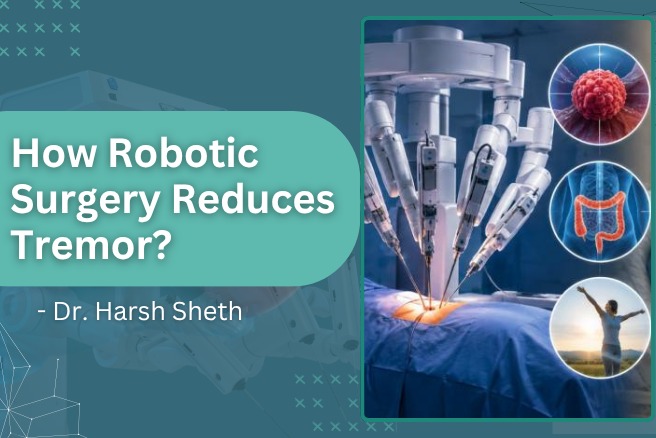
Robotic surgery lets a surgeon work with a steadier hand inside the abdomen. The console strips out the small natural tremor in the hands and turns each broad hand movement into a much finer one at the instrument tip. That matters in complex gastrointestinal operations, where tissue is fragile and there is very little room to work. The surgeon controls every step.
According to Dr. Harsh Sheth, bariatric and advanced laparoscopic surgeon in Mumbai, “Every surgeon’s hand has a slight tremor, especially after a long case. The robot doesn’t replace the surgeon’s judgement. It steadies the movements that judgement asks for.”
Considering a robotic procedure? Call +91 91370 80299 to book a consultation with Dr. Harsh Sheth.
How Does Robotic Surgery Reduce Hand Tremor?
Hold your arm out for a minute and you’ll see your hand shake. Every surgeon’s does. In standard keyhole work, that shake travels down long, rigid instruments and shows up at the tip. At the robotic console it doesn’t get that far. The system smooths it out and scales the movement down, so a few centimetres of hand travel turns into a millimetre or two inside the patient. Add a magnified 3D view and instrument tips that bend like a wrist, and awkward corners get easier to handle than with straight keyhole instruments.
Why Does Steadiness Matter in Complex GI Procedures?
Think about where the work happens. Deep in the pelvis, or tucked high under the ribs, with nerves, blood vessels and thin-walled bowel packed close together. A slip of a millimetre there is not small.
Long cases add another problem, which is tiredness. At the console the surgeon sits supported, with arms rested, so there’s less strain and, in practice, a steadier hand towards the end of a long operation. That is the real case for robotic GI surgery. The machine isn’t clever on its own. It does exactly what the surgeon tells it to, and the conditions we treat this way are covered on our gastrointestinal surgery and treatment page.
What Determines Whether Robotic Surgery Is Right for You?
Four things decide it. The first is the hernia itself: how big it is, which side, and whether it has come back after an earlier repair. The second is how much it bothers you. Then comes your general health, such as a chronic cough, constipation, your weight, or blood thinners you take. Last is your work, because a man who carries loads all day needs a different plan from one who sits at a desk. After an examination, we put these together and decide with you.
Key Takeaways
- Robotic surgery filters out the surgeon’s natural hand tremor and scales movements down so they are steadier.
- Every movement still starts with the surgeon’s hands. The robot doesn’t act on its own.
- The gain is biggest in long, complex GI operations done in tight spaces.
- Not everyone needs robotic GI surgery, and the right choice depends on the operation and your health.
- To book a consultation with Dr. Harsh Sheth, call +91 91370 80299.
Frequently Asked Questions
Can the robot move on its own?
No. Every movement starts with the surgeon’s hands at the console. The system only smooths and scales them.
Is robotic surgery safer than keyhole surgery?
Not by itself. Results depend on the operation and on the surgeon’s experience. Where the robot helps is precision in tight spaces.
Will I need robotic surgery for my GI problem?
Not necessarily. Many operations do well with keyhole or open surgery, and your surgeon will recommend what suits you after an examination.
Will I recover faster after robotic surgery?
It is often similar to keyhole surgery, because both use small cuts. How quickly you recover depends mostly on the procedure and your general health.
References
- Mayo Clinic – Robotic Surgery. Explains how robotic-assisted surgery works and its potential benefits and risks. Link: https://www.mayoclinic.org/tests-procedures/robotic-surgery/about/pac-20394974
- Cleveland Clinic – Robotic Surgery. Describes how surgeons control instruments through a console and which procedures use it. Link: https://my.clevelandclinic.org/health/treatments/22119-robotic-surgery
Disclaimer : This blog is for educational and informational purposes only and should not be considered professional medical advice. Please consult a qualified surgeon before making any dietary or medical decisions following gallbladder removal.
