


Ask most people about hernias and they picture the groin. The belly button gets far less attention, yet an umbilical hernia in adults is the second most common abdominal wall hernia, right behind the groin type, making up roughly 6 to 14 percent of all of them. About nine in ten are not something you were born with. They develop later in life, as years of pressure test a spot in the wall that was never very strong. That is why so many adults are surprised to find a soft lump by the belly button.
According to Dr. Harsh Sheth, laparoscopic surgeon in Mumbai, “The navel is the one place where the belly wall is naturally thin, so extra strain from weight, pregnancy or lifting finds it first. A small bulge that doesn’t hurt still deserves a proper check, because its size and symptoms decide what happens next.”
Wondering whether a small swelling near your belly button needs attention?
What Makes Adults Develop a Hernia at the Navel?
This spot is a built-in weak point, and everyday strain slowly tests it.
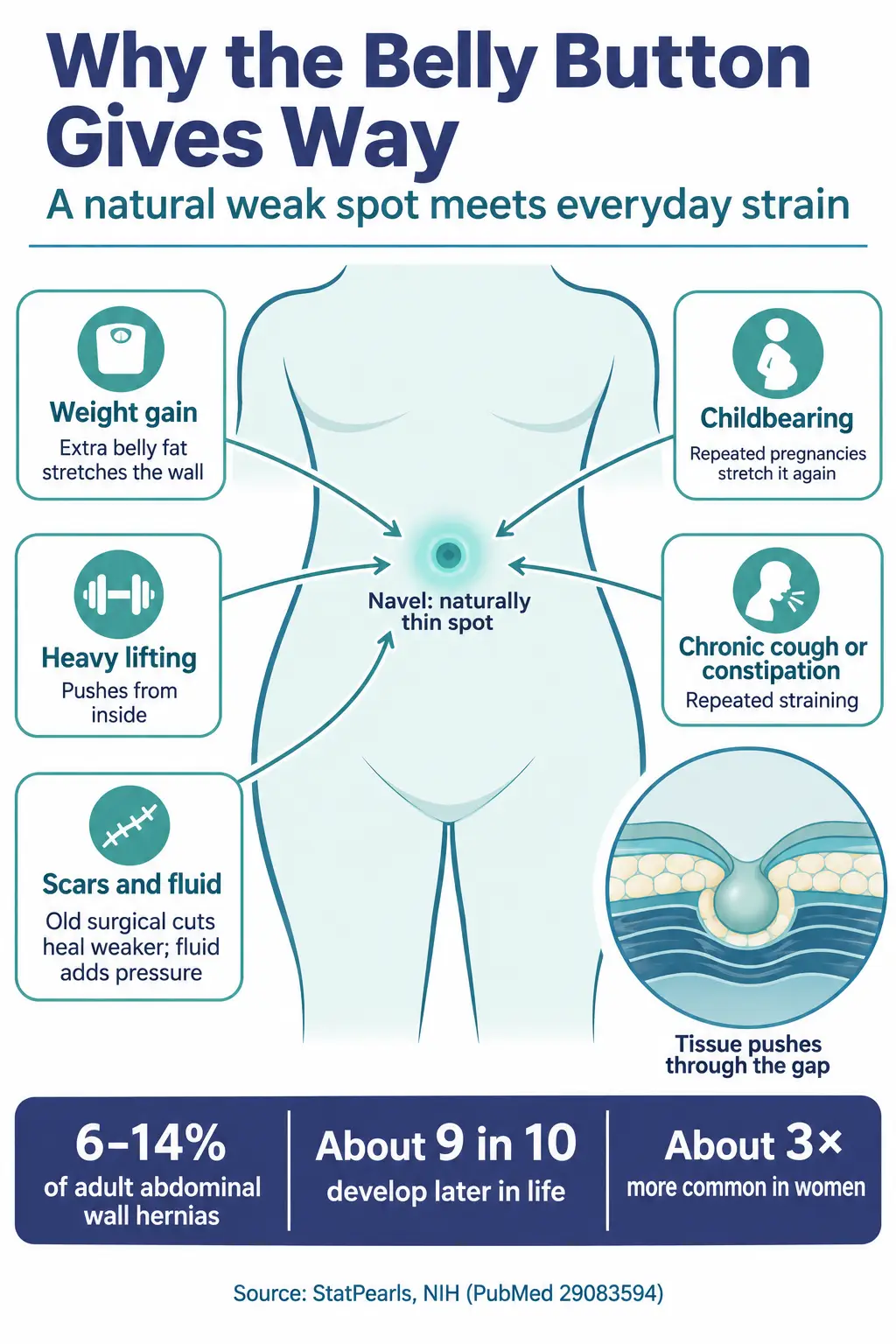
- Natural weak spot: The cord once passed through here, so the wall never seals as firmly as it does elsewhere.
- Weight and childbearing: Extra belly fat and repeated pregnancies keep stretching the area. Women are affected about three times as often as men.
- Straining and coughing: Heavy lifting, a long-standing cough or constipation push from inside again and again.
- Scars and fluid: Old surgical cuts heal weaker than normal skin, and fluid build-up in the belly adds pressure.
The hernia surgery page describes how defects in the abdominal wall are assessed and treated.
What Are the Symptoms, and When Is It Serious?
Most adult hernias begin as a soft, painless swelling, but a few signs change the picture.
What you notice | Usually manageable | Needs urgent care |
Lump | Soft, pops out on standing or coughing, settles when lying down | Hard, tender, and won’t go back in |
Pain | Dull ache or pulling feeling after activity | Sudden, severe pain that doesn’t ease |
Skin | Normal colour | Red, purple or dark over the area |
Digestion | Normal | Vomiting, bloating, no gas or stool passed |
Size | Steady or slowly growing | Larger within days |
- Soft bump: A bump beside the belly button that appears with coughing or standing and settles when you lie down.
- Dull ache: A pulling or heavy feeling, often after lifting or a long day on your feet.
- Is it serious: Usually not. Bowel getting trapped is uncommon, with a lifetime risk of about 1 to 3 percent, but it is an emergency.
- Emergency signs: A hard, painful swelling with vomiting, fever or skin colour change needs same-day care.
If the lump first appeared after an operation, the belly button hernia after surgery blog may fit better.
Will It Go Away on Its Own, and Can You Live With It?
In babies the belly button often closes by itself, but in adults it doesn’t.
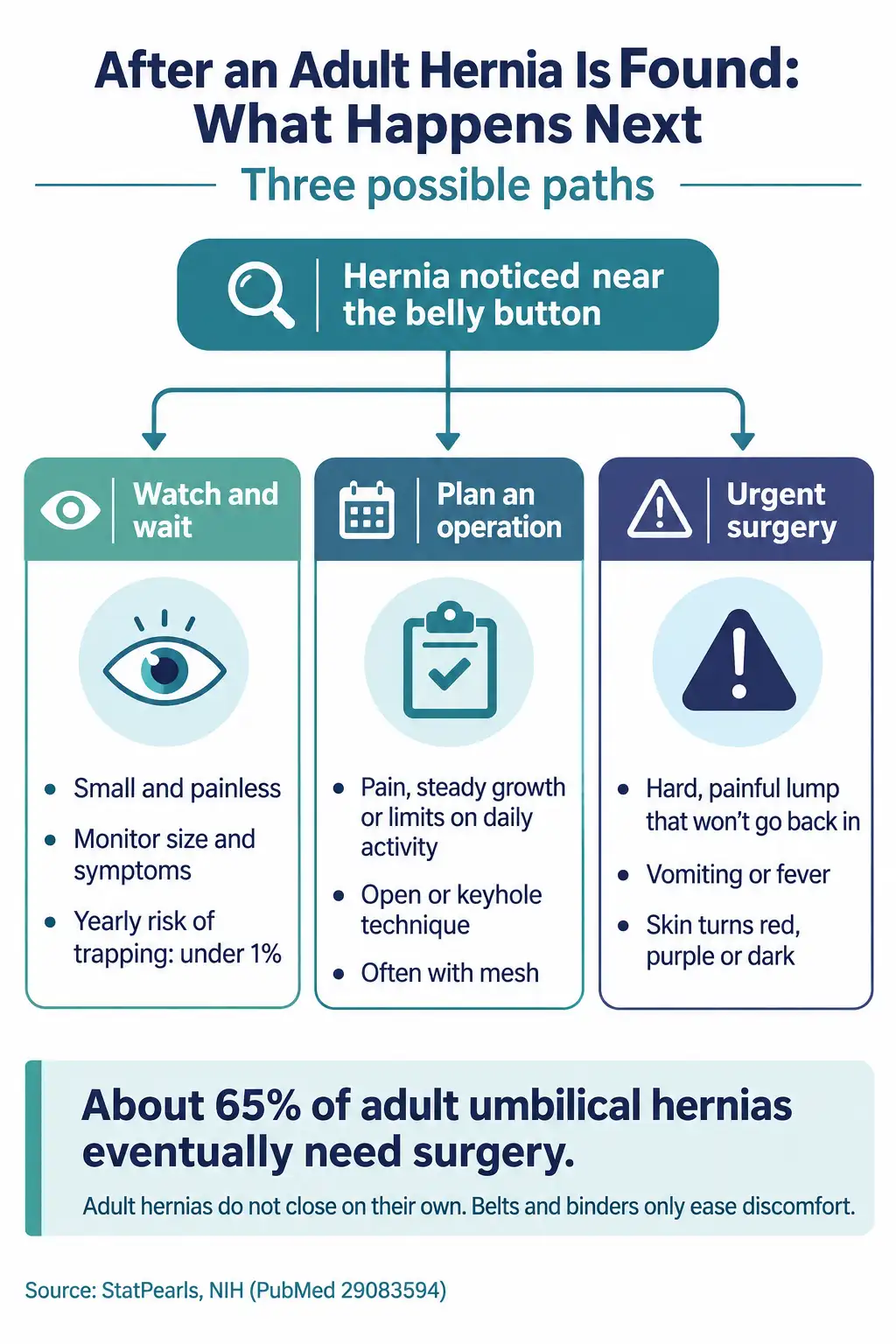
- No self-healing: An adult hernia does not shrink away, and belts or binders only ease discomfort.
- Watchful waiting: A small, painless hernia can be monitored, and the yearly risk of trapping is under 1 percent. About 65 percent eventually need an operation.
- When surgery is advised: Pain, steady growth or trouble with daily activity usually tip the decision towards an operation.
- Repair options: Open or keyhole technique, often with mesh, chosen by hernia size and your general health.
More on how mesh is chosen is in the robotic hernia repair with mesh blog.
Frequently Asked Questions
Is an umbilical hernia serious in adults?
Usually not, but a hard, painful, stuck bulge needs urgent care.
Can you live a long life with a belly button hernia?
Yes, many do, provided it is monitored and warning signs aren’t ignored.
Can a belly button hernia go away without surgery?
In adults, no. Support belts only ease discomfort.
What are the symptoms of a hernia near the belly button in adults?
A soft bulge that shrinks lying down, often with a dull ache.
References
- Coste AH, Jaafar S, Parmely JD. Umbilical Hernia. In: StatPearls. Treasure Island (FL): StatPearls Publishing. PubMed
- Elective Umbilical Hernia Repair in Adults in the 21st Century: Challenging the Status Quo. J Clin Med. 2025;14(17):6324. PMC
Disclaimer : This blog is for educational and informational purposes only and should not be considered professional advice.
